Vidit Agarwal, August 2019
The Facts
The Trump administration imposed tariffs on $34 billion worth of Chinese goods, including flat-screen televisions, aircraft parts, and medical devices. The goods marked for tariffs will now face a punishing 25% tax when they’re imported into the US. The point is to punish China by making Chinese products more expensive for American consumers and businesses to buy. Trump stated that if he put tariffs on Chinese goods, then the trade deficit would decrease. If Chinese products suddenly become more expensive, they’ll buy those same products from somewhere else, and Chinese businesses will lose money. China immediately accused the US of starting “the largest trade war in economic history to date” and responded by imposing 25% tariffs on $34 billion worth of US goods, including soybeans, automobiles, and lobsters.
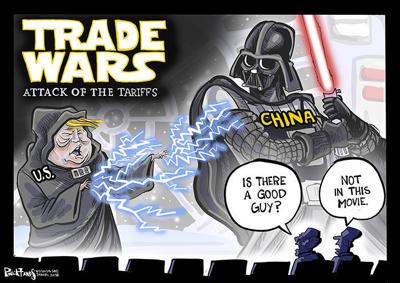
The Trump administration initiated these tariffs after concluding an investigation into some of China’s most controversial trade practices. The US’s new trade barriers are designed to penalize China for doing things like forcing foreign businesses to hand over their most prized technology to Chinese companies — many of which are state-owned — in exchange for access to their market. The US imposed taxes on an additional $16 billion worth of Chinese goods in two weeks. Trump also said that, depending on how China responds to his tariffs, he’s considering hitting another $500 billion worth of Chinese goods.
Both the US’s and China’s initial round of tariffs against each other are designed to hurt both countries economy’s by basically targeting their weaknesses. The US is targeting high-tech Chinese goods to put economic pressure on Beijing’s “Made in China 2025” program — a Chinese government plan to transform China into an advanced manufacturing powerhouse. China has deliberately targeted big US agricultural exports like soybeans that come from states in the heart of Trump country, where neither the president nor his party wants to see a failing economy or job losses. So that means we’re officially in a trade war with China? It depends.
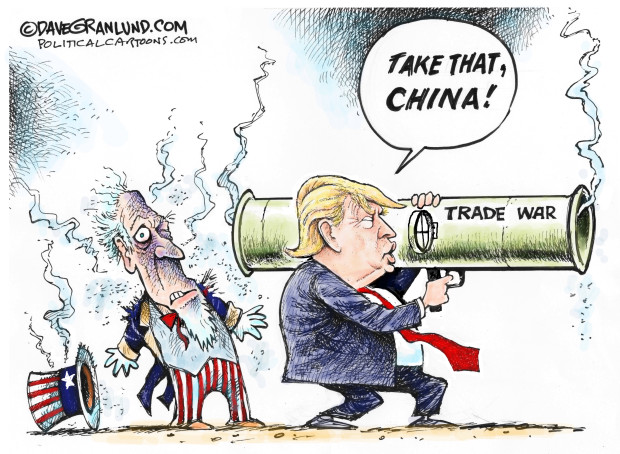
Countries get into tussles over trade all the time. To sort them out, they can go to the World Trade Organization and have them decide who’s right and who’s wrong; they can negotiate directly with each other to strike a deal; or they can just impose tariffs on each other’s goods. The last option has the potential to turn into a trade war. If two countries shoot at each other’s economies then it’s not a huge deal. But if the punch-counterpunch continue with each country putting more and more tariffs on one another, then you’ve got a trade war.
My Opinions
I believe the United States could have avoided its current predicament by using the World Trade Organization’s existing resolution, where they help out instead of letting it rest on the Chinsese and American shoulders. This means that instead of asking help from a “grown-up,” like the World Trade Organization, they are trying to solve it by themselves even though they both act like incompetatent toddlers in this war.
Still, from the perspective of a single country, starting a trade war could potentially be justified if the end result is them winning. Such a victory can only be achieved when the country has a bargaining advantage that its opponent doesn’t — in other words when it can impose more pain on its opponent than it expects. The longer the trade war continues, the more importance is there for the country to win in order to compensate for the damage caused. So, after nearly 18 months of escalating disputes between the U.S. and China, where are we? Is either side winning, and can any actions be justified for the economic harm that both sides have already experienced?
After days of reasearch, my answer is sadly China. Twenty years ago, the situation might have been different. China was dramatically underdeveloped, and it wanted access to Western technology and manufacturing techniques. It was a different time and the result would be different. Now, China has most of what it needs, and what it doesn’t have it can easily obtain from others outside the U.S. The fastest growing markets for the best items China produces, like laptop computers and cell phones, are in developing regions such as India, Latin America, and Africa. In contrast, China itself is a market that the U.S. can hardly ignore. By the end of 2015, Chinese consumers bought 131 million iPhones. The total sales to U.S. customers during the same period stood at only 110 million. And iPhones are only a small part of U.S. exports. Boeing, which employs 150,000 workers in the U.S., estimates that China will buy some 6,810 airplanes over the next 20 years, and that market alone will be worth more than $1 trillion.
When Trump started the trade war, the most immediate effects was felt by companies like Walmart, which import billions of dollars of cheap goods that are bought mostly by the people who voted Trump into office. The prices on almost all of these items would quickly skyrocket beyond the reach of the lower economic brackets—not because of manufacturing costs, but because of the tariffs. The result would be an economic war that China is infinitely better positioned to win.
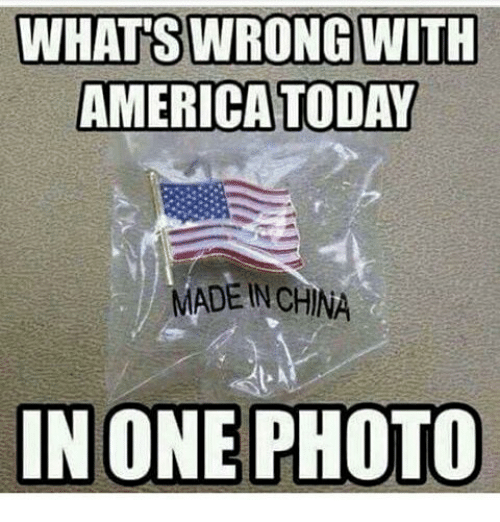
China’s foreign currency reserves now stand at more than $3 trillion. In contrast, the U.S. has foreign exchange reserves that hover at around $120 billion. Trump’s tariffs would automatically trigger penalties against the U.S. in the World Trade Organization. While it might take a while for that to happen, the turmoil would be catastrophic for American business and employment. China, on the other hand, would emerge relatively unscathed.
In fact, the importance of the U.S.-China relationship is already being challenged by other players. The Chinese would happily shift their trillion dollars in future aircraft purchases to Airbus, a European firm that is already building a plant in China to finish assembly of large, twin-aisle jets. As for automobiles, most Chinese would just as soon drive any American car.
It doesn’t look good for the United States, but that’s just me. Maybe Trump has some special weapon up his sleeve, but it doesn’t look good for the red, white, and blue.
Mercurynews.com. (2019). Cartoons: Trade Warz China vs. United States. [online] Available at: https://www.mercurynews.com/2017/11/16/cartoons-donald-trump-and-china/
Mercurynews.com. (2019) Cartoons: Donald Trump and China. [online] Available at: https://www.mercurynews.com/2019/05/14/political-cartoons-trade-war-2/
Politicalmemes.org. (2019) Whats wrong with the US in just one photo: https://www.scmp.com/comment/insight-opinion/united-states/article/2169277/not-just-containment-americas-real-goal-may-be
 Sports, Philosophy, Economy, Politics, Social and more...